Intel Academic Centre of Excellence
Intel Academic Centre of Excellence
For over four years, Durham University’s Department of Computer Science has been hosting Intel’s first United Kingdom (UK) oneAPI Academic Centre of Excellence (CoE). With Intel’s support, the centre conducts research into task-based programming using oneAPI for heterogeneous architectures. Our goal is to extend the hyperbolic PDE engine ExaHyPE into a OneExaHyPE code that scales across a wide variety of GPU-accelerated machines but also performs well on a traditional CPU.
For many simulation codes – such as our own code ExaHyPE which we use to simulate gravitational waves and seismic waves (earthquakes) – it is absolutely key to port them to GPUs. These “graphics cards” are the driving force behind the most powerful supercomputers in the world. Due to the focus on the GPUs, many research groups give up on the idea to exploit classic CPUs efficiently. They go all in on GPUs. Beyond that, they have to change how they compute things: GPUs are very good if compute work is very homogeneous, similar to an image consisting of pixels which all have exactly the same size. Many phenomena exhibit localised properties, such as the rotating black holes or the source of an earthquake, where you want to zoom into the black hole or the fault, respectively, while it is sufficient to resolve all the area around these features with reduced accuracy. To keep calculations regular, many GPU codes resolve uniformly over wide regions to a preserve sufficient data structure regularity. They sacrifice computational efficiency (only compute what you absolutely need and use the significant capabilities that CPUs continue to offer) for GPU efficiency (compute as regular as possible).
In the centre of excellence, we go down a different route and really look at programming techniques that made CPUs so successful. Notably, we study task-based parallelism and ask if these established mechanisms can be made a fit to GPUs, too. The answer is yes, but it requires work: (i) We need the right algorithms and algorithmic formulations, (ii) we need the right software infrastructure that maps calculations that are efficient on CPUs onto efficient orchestrations on GPUs, and (iii) we need a language such that developers write code only once, but it then works over either system type.
Within the Centre, we tackle point (i) as part of our day-to-day research, but we collaborate with Intel staff to extend Intel’s open source software stack such that it facilitates (ii). Finally, we rewrite parts of ExaHyPE in SYCL (cf point (iii)), a platform-agnostic way to write code that runs on both CPUs and GPUs, and stress-test this paradigm together with Intel colleagues, i.e. evaluate to how production-ready it already is over a variety of vendors.
Intel’s sponsoring supported the PhD research for Pawel Radtke (left) and Timothy Stokes (right) at the Department of Computer Science.
Success stories
The Durham work has led to direct contributions to Intel’s OneTBB software package. For example, we pushed for the introduction of higher-dimensional ranges in the iterator – similar to C++’s new ranges – and we introduced an API extension which facilitates dynamic task graph assembly. We are even working on algorithms to deploy parts of dynamic task graphs efficiently to GPUs. Due to rigorous analyses, we were able to flag inefficiencies in the OpenMP runtime as well, and we have outlined how SYCL GPU compilers could arrange and orchestrate calculations more efficiently. Finally, we also made suggestions on how to extend current C++ compilers such that they streamline and simplify GPU programming. All of this work feeds back into the open source community and hence enables further progress in the field, benefiting the wider community beyond our own research and Intel’s products.
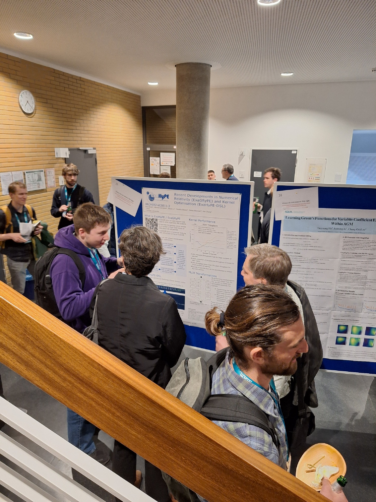
Further to the core research, the project presented our work at international conferences, we provided infrastructure and support to help Intel staff to publish the first Grace Hopper SYCL port, and we also organised SYCL hackathons and tutorials that had been open to the entire UK research community to acquire new skills. The biggest event showcase was undoubtedly a SYCL workshop and hackathon at the 2025 Durham HPC Days.
On Durham’s side, seeing two PhD students, Pawel Radtke and Timothy Stokes, graduating with excellent research outcomes will be a major reward. A recent award for a poster provides evidence for the excellent early career contributions of these collagues.
Publications
- Efficient GPU Offloading with OpenMP for a Hyperbolic Finite Volume Solver on Dynamically Adaptive Meshes
- Detrimental task execution patterns in mainstream OpenMP® runtimes
- ExaGRyPE: Numerical General Relativity Solvers Based upon the Hyperbolic PDEs Solver Engine ExaHyPE
- Compiler support for semi-manual AoS-to-SoA conversions with data views
- Annotation-guided AoS-to-SoA conversions and GPU offloading with data views in C++
- Compiler-supported reduced precision and AoS-SoA transformations for heterogeneous hardware
- SYCL compute kernels for ExaHyPE
The papers show the great range of where we have applied key technologies developed for and with Intel already. They also provide evidence how many links outside of Durham we have established under the umbrella of the project.
Further links